#dacryl #innovation #sustainability #acrylic #recycling #material
ABOUT US :
Dacryl is a French maison of artistic craftsmanship, specialized in the design and production of decorative cast acrylic panels. Based in the heart of France and distinguished with the Ateliers d’Art de France label, our manufacture has been cultivating for more than twenty years a unique expertise in the creation of synthetic materials of exceptional purity, combining artisanal savoir-faire, innovation, and technical mastery.
Historically recognized for its work with light and the art of inclusion—embedding botanicals, textiles, pigments, or metals within acrylic—Dacryl today operates at the crossroads of craftsmanship and applied research. All our panels are produced entirely in-house, ensuring full traceability, uncompromising quality, and long-term durability.
Beyond the aesthetic dimension, we develop materials that are stable over time, guaranteed for ten years, rot-proof and non-yellowing, preserving both their technical and visual properties even after many years of use.
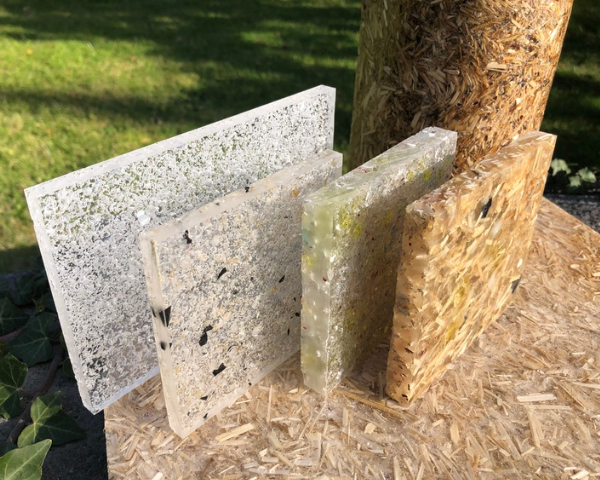
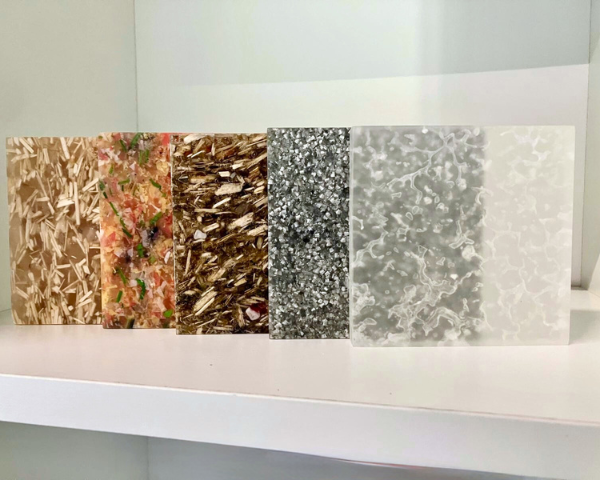
Building on this foundation, we have created a collection of recycled materials, developed in close collaboration with industrial partners from diverse sectors. The goal is twofold: to valorize their production waste by giving it a second life within innovative acrylic panels, and to open new decorative or commercial opportunities through the creation of unprecedented materials. For example, agricultural straw has been transformed into compact, durable surfaces for public institutions; fabric offcuts from fashion houses have been integrated into decorative panels; waste from the paper industry has been reimagined into recycled, sustainable supports; and even unexpected materials, such as discarded flip-flops, have been revalorized into unique decorative matter.
In parallel, our teams conduct advanced technical research that has led to two major innovations: a bullet-resistant material designed to enhance safety for public institutions, and an anti-radiation material developed for protection against nuclear radiation in power plants.
These developments demonstrate Dacryl’s ability to merge design, innovation, and responsibility, delivering tailored solutions that address not only aesthetic requirements but also environmental and technical challenges.
Our ambition is clear: to continually push the boundaries of decorative acrylic by embedding it in a sustainable, innovative, and forward-looking approach.
Recycled Textile Components
We recover offcuts and accessory elements from the textile industry, such as labels, padding from down jackets, and textile scraps. These heterogeneous materials are usually complex to recycle and often discarded. Working with a major French fashion brand specialised in ski and outdoor apparel, we developed an innovative recycled material integrating these textile components into a recycled acrylic matrix. This process allows layered fibres and soft elements to be structurally stabilised, creating a distinctive surface where texture, depth and material contrast become key features.
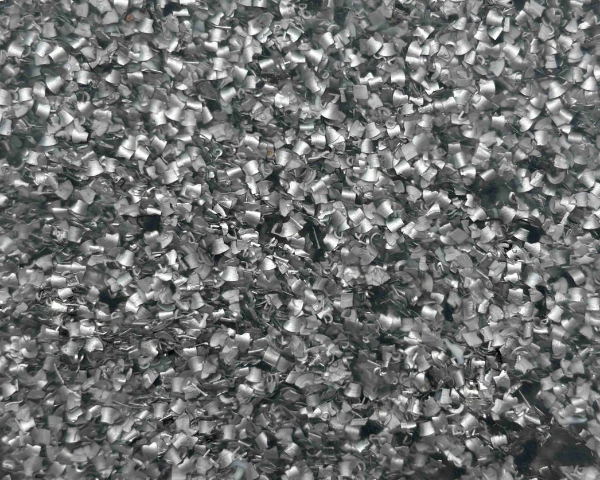
Recycled Aluminium Flakes
Derived from machining industry waste, these aluminium flakes come from multi-material manufacturers producing chips from metal, polypropylene, polystyrene or PMMA. Usually destined for landfill, these by-products are instead recovered and revalorised. We collect, sort and integrate them at high density into a recycled acrylic matrix. This casting process creates a new aesthetic and technical material: durable, moisture-resistant and robust, transforming industrial waste into a high-value recycled surface.
Recycled Composite Paper
This material is made from industrial paper waste reinforced with polyester resins and fillers. Once combined with these resins, such papers can no longer enter conventional paper recycling streams and are usually discarded. We recover these non-recyclable papers and integrate them into a recycled acrylic matrix, giving structure and cohesion to heterogeneous fibres. The result is a homogeneous, stable surface, where the original paper fragments remain visible and become an integral part of the material’s identity.

OUR ECO-RESPONSIBLE COMMITMENTS
Dacryl® uses recycled MMA (R-Life™ from Trinseo), recycles 98% of its production offcuts in-house thanks to its own equipment, and manufactures exclusively on demand. Our production process does not exceed 50°C, ensuring very low energy consumption. We have developed a collection of 100% recycled materials, combining our own PMMA waste with DIB (non-hazardous industrial waste) from local authorities and industrial partners. These high-density inclusions are encapsulated in recycled PMMA to create rot-proof, highly resistant, aesthetic and high-performance panels, offering properties equivalent to compact materials. We prioritise French and European partners.
1. A recycled raw material: R-Life™ MMA (Trinseo)
Our production is based on a certified recycled MMA, R-Life™ MMA from Trinseo, ensuring high-quality PMMA with a significantly reduced carbon footprint.
Key advantages:
- Monomer derived from 100% recycling streams
- Optical quality equivalent to virgin MMA
- Major reduction in emissions linked to conventional extraction and polymerisation processes
2. A 100% recyclable material & 98% of offcuts recycled in-house
Dacryl® PMMA is fully recyclable.
We have implemented an almost closed-loop internal system:
- 98% of our offcuts are reintegrated into production
- Systematic sorting in the workshop
- In-house grinding using dedicated equipment
- Re-casting new material from these offcuts
- No PMMA waste sent for disposal
Our material is therefore recycled, recyclable, and continuously revalorised.
3. Our DIB recycled materials collection
This is the core of our advanced circular approach.
3.1. A dual-flow circular process
The Dacryl® recycled materials collection combines:
- our own PMMA offcuts (98% recycled),
- waste from industrial activities (DIB – non-hazardous industrial waste).
Sources of external waste include:
- non-valorised organic materials,
- production offcuts,
- non-conforming parts,
- products from previous collections (textiles, for example).
These materials, previously destined for incineration or landfill, become locally valorised resources.
3.2. Grinding, transformation and reintegration
We have invested in our own grinding equipment, enabling:
- controlled particle size processing,
- transformation into reintegrable particles,
- full traceability,
- independence from external recycling channels.
The resulting granules are then mixed with our recycled PMMA matrix.
3.3. Very high-density inclusions: a new technical material
Unlike purely decorative materials, our inclusions are integrated at very high density, fundamentally enhancing the material:
- improved mechanical properties,
- high rigidity,
- reduced absorption,
- increased durability.
The result is a hybrid material, combining recycled PMMA and crushed waste.
Technical properties include:
- performance equivalent to compact panels,
- rot-proof (resistant to water and humidity),
- long-term dimensional stability (unlike OSB or MDF),
- high mechanical resistance,
- easy maintenance,
- suitability for intensive use.
In other words: a new-generation OSB or MDF, fully rot-proof and made from recycled materials.
3.4. Premium aesthetic qualities
We fully control the visual appearance of the material:
- inclusion density,
- colours,
- transparency or opacity,
- textures.
Unlike conventional recycled materials, our panels offer a premium aesthetic, suitable for design, architecture, urban planning, sustainable furniture and signage.
3.5. Potential applications
These next-generation materials are particularly suited to the needs of local authorities and industrial partners:
- partitioning and construction panels,
- interior and exterior cladding,
- urban or educational furniture,
- wall and surface coverings,
- technical boards,
- upcycling of end-of-life products into new designs.
4. Low-energy production process (≤ 50°C)
We have redesigned our casting process to ensure:
- no production exceeding 50°C,
- a significant reduction in energy consumption,
- a more stable, cleaner and more efficient process.
5. On-demand production: zero overstock
To limit waste and carbon impact:
- no anticipatory production,
- manufacturing exclusively to order,
- no unnecessary storage.
This guarantees fully controlled use of resources.
6. Responsible and local sourcing
We prioritise:
- French suppliers,
- or, where necessary, European suppliers,
in order to reduce transport impact, improve traceability, and support cleaner supply chains and higher-quality products.
NEW INNOVATION
Dacryl® develops this entrepreneurial project aimed at becoming a reference integrator and facilitator of new materials based on DIB (non-hazardous industrial waste) and other complex, hard-to-recycle or end-of-life materials. We work alongside industrial partners to transform waste streams considered without a future into high-performance, durable and aesthetic surfaces. By combining recycled acrylic matrices with heterogeneous DIB components, we offer industries a concrete solution to give their materials a second life through a circular, value-driven and application-oriented process.
CONTACT US
Gilbert MEYERFounder & CEO
E-mail : g.meyer@dacryl.com
Tél. : +33 (0)6 07 33 96 16 – +33 (0)1 86 95 83 30
1, rue de Saint-Imbert – 58240 – Chantenay-Saint-Imbert – FRANCE
www.dacryl.com